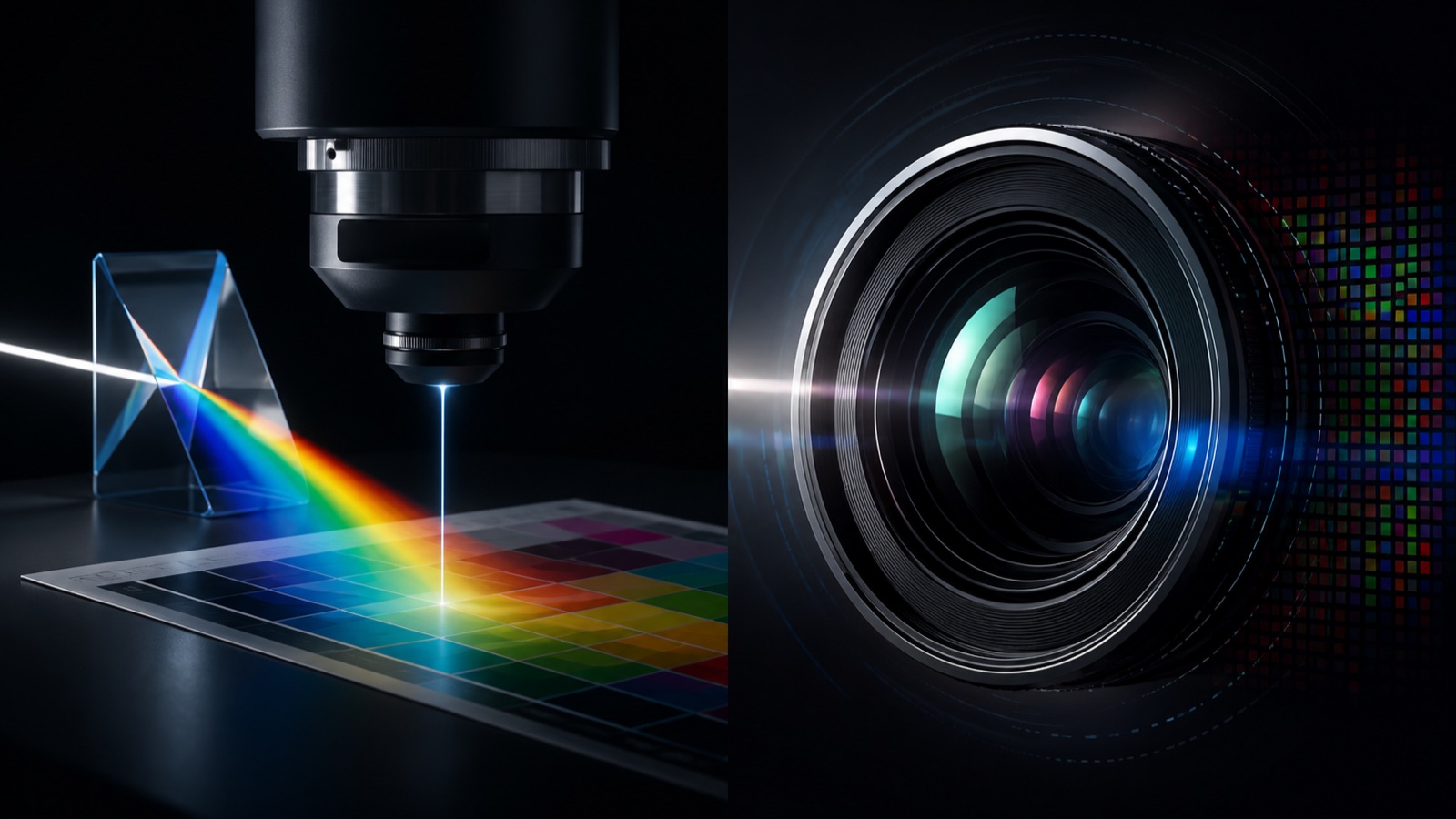
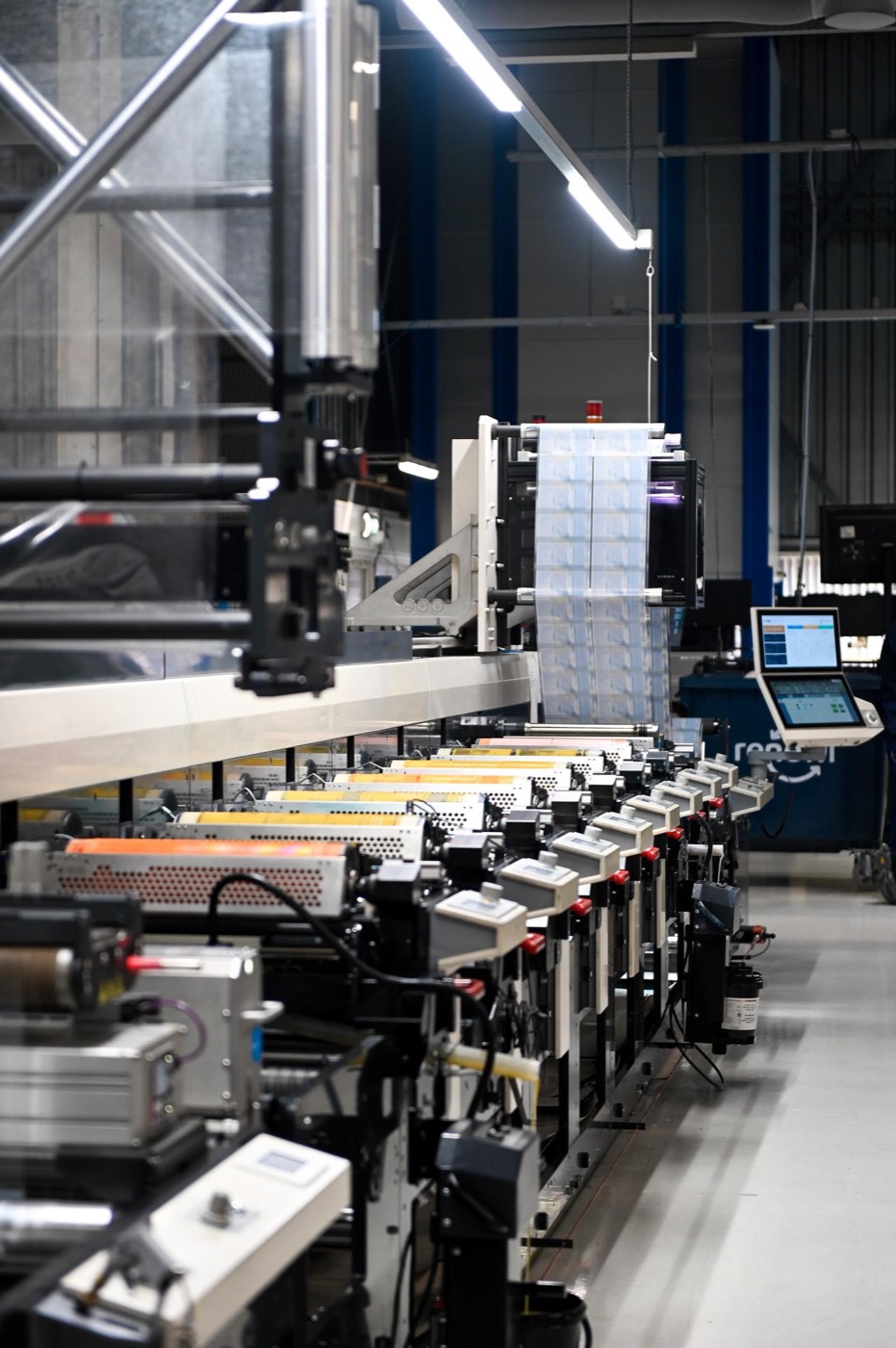
Most inline color systems force a compromise — the accuracy of a spectrophotometer, or the speed of a camera, but rarely both. Multispectral imaging is how DeltaOne refuses that trade. It captures full spectral data across the moving web and turns it into L*a*b* and ΔE while the press runs at speed.
Why an RGB camera isn't enough.
An RGB camera sees color the way a screen does — three broad channels, red, green, and blue, tuned to the human eye. That is fine for a preview. It is not measurement. Two inks that look identical under one light can have completely different spectral signatures, and an RGB sensor collapses that difference into the same three numbers. Change the illuminant and the match falls apart. For color control on packaging — where a brand red has to be the same red across substrates, presses, and print runs — three channels simply don't carry enough information.
A single-point spectrophotometer solves the accuracy problem but creates a new one. It reads one patch, in one place, with the press stopped or the web sampled offline. You learn what the color was at that point, after the fact. On a long run, the deviations you care about happen between samples — and you find out only when the next sheet is already printed.
What multispectral imaging captures.
DeltaOne sits between those two worlds. Instead of three broad channels, it resolves the visible spectrum into 36 narrow bands at 10 nm intervals — a spectral curve for every measured point, not an approximation of one. That curve is the raw material of real color science: it describes how the ink reflects light wavelength by wavelength, independent of any single viewing condition.
Because the measurement is spectral rather than tristimulus, the same capture can be evaluated under any standard illuminant — D50 for a proofing standard, D65 for daylight — without re-measuring. The spectrum is the source of truth; the illuminant is just a lens you apply to it afterward.
Reading the web, not a sample.
An imaging sensor measures an area, not a point — and that changes what inline color control can be. DeltaOne scans across the web and reads colorbar patches as small as 2 × 2 mm, the tightest in the industry. Smaller patches mean less substrate spent on the colorbar and more available for the printed design, on every impression.
The instrument finds the bar itself. A motorized system locates the colorbar wherever it falls on the web, positions to it, and measures — including colorbars on both sides of the web — with no operator setup per job. Across a 50 mm measurement width, the same imaging path that captures spectra also verifies patch shape, size, and registration, so the data leaving the sensor is geometrically sound before any color value is computed.
From spectrum to ΔE, in real time.
Capturing spectra at press speed is only half the problem. The other half is turning them into a number an operator can act on before the deviation becomes waste. Each band's reflectance is combined under the chosen illuminant and standard observer to produce CIE L*a*b* coordinates, and from there the ΔE distance between the printed color and its target.
Doing this for a full-width image, continuously, at up to 500 m/min is a hardware problem before it is a software one. The processing runs close to the sensor — the kind of fixed-function, parallel pipeline an FPGA is built for — so the conversion from raw spectra to L*a*b* keeps pace with the web instead of buffering behind it. The result is a measurement that is genuinely inline: live, not sampled.
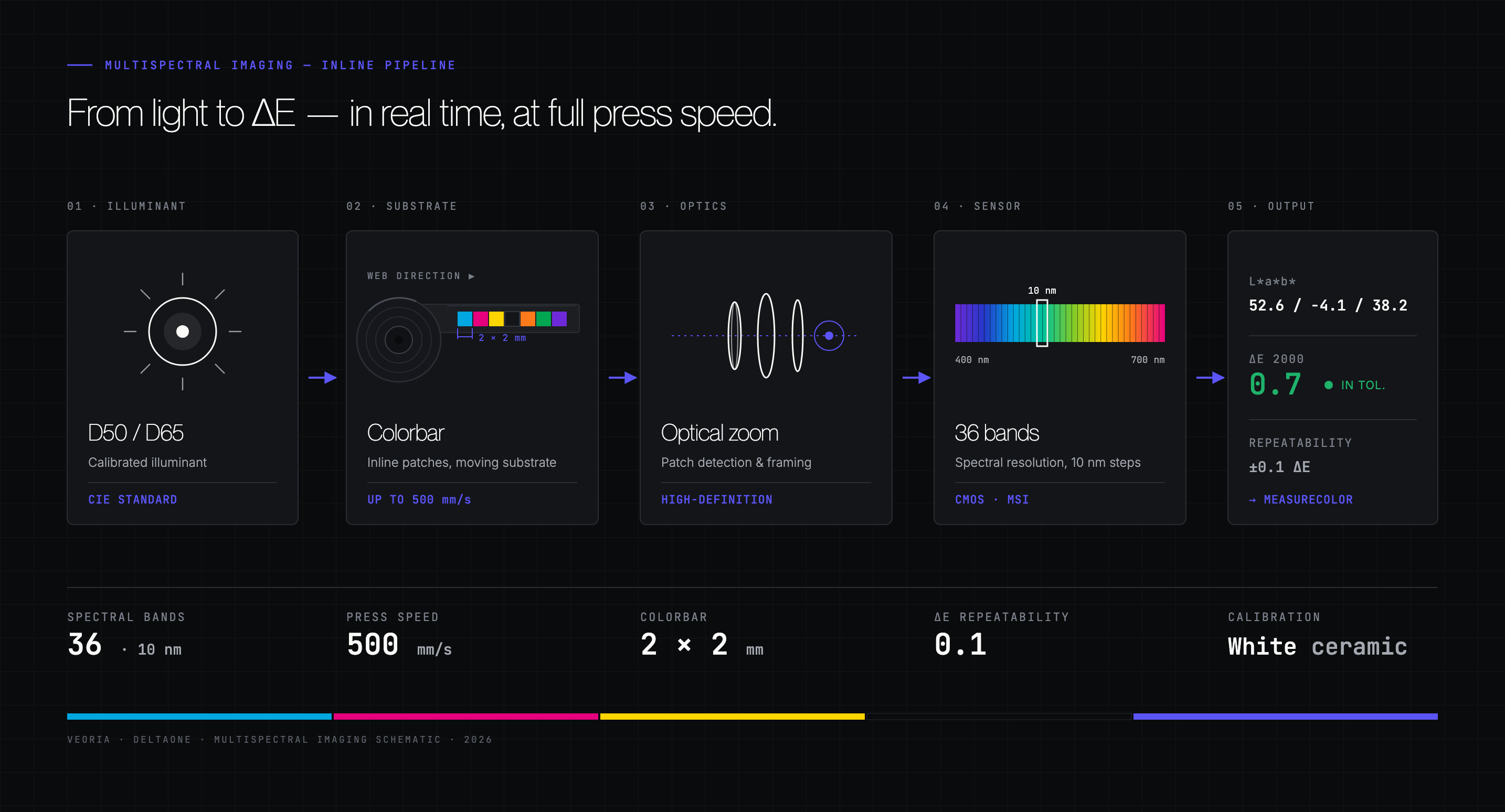
That speed is also what protects the numbers. With a white ceramic reference and automatic calibration, DeltaOne holds 0.1 ΔE repeatability across a run, and 0.3 ΔE inter-instrument agreement from one unit to the next — so a measurement on one press means the same thing on another.
From measurement to decision.
A measurement is only useful if it reaches the people who act on it. DeltaOne runs Veoria's own on-press software: the spectral data becomes a quality score, a per-ink ΔE against aim, and the correction to make — in front of the operator, while the run keeps moving.
Because the output is spectral rather than a fixed set of values, DeltaOne is not locked to a single software stack — the same data exports to MeasureColor, ChromaChecker, and other major color management tools. The loop closes either way: the sensor measures, the software decides, and the operator corrects.
That is what multispectral imaging actually does. Not a prettier picture of color — a faithful, illuminant-independent measurement of it, fast enough to live on the press instead of beside it.
See the full DeltaOne specification.
Every band, tolerance, and dimension — plus the press technologies DeltaOne fits.
Explore DeltaOne